Transcript
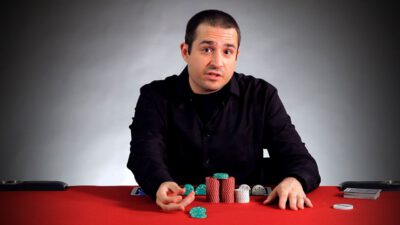
Hey, I’m Professional Poker Player Nicky Numbers, and today I’m going to explain a little bit about some of the considerations that should go into your pre-flop strategy.
It’s all about identifying what factors should go into your decision making process.
The first thing that you want to identify is the blinds. How big or small are they relative to your stack? How many chips are in your stack? How many chips are the in stacks of your opponents? What’s the average stack, or better yet, the median stack at your table?
Your position at the table relative to the button pre-flop is also incredibly important. It lets you know how many players are yet to act after you.
In addition, you want to take into account the players that have acted before you, the positions they were in and the actions that they’ve taken. And that’s not even getting into your opponents’ betting patterns, their tendencies, the size of their wagers, and whether or not the actions that they take at the table are indicative of how strong or weak their holdings may be.
After evaluating all of those factors, you’ll be able to better put your opponents on a range of hands, that is, all the cards that they may have played the same way.
And of course, after evaluating all that, you still have your cards to take into account. However, it’s important to understand that in No Limit Hold ‘Em, cards have relative hand strength not absolute hand strength. There’s 169 different hold cards that you can be dealt. Each one of them has an absolute ranking, however the absolute ranking should rarely inform your decision.
It’s the relative strength that’s important. How does your hand compare to your opponents’ range? Can you continue profitably? Are you ahead of their range? Are you behind their range? If you’re behind in the hand, are you getting odds to continue? If you’re not getting odds to continue and you don’t believe that your hand is ahead of your opponents’ range, then the only question you really have to ask yourself is if you take an aggressive action, will you be able to make your opponents fold with a high enough frequency such that the aggressive action can be profitable?
These are just some of the factors that could be evaluated pre-flop, and when used with deductive reasoning, they’ll significantly inform your decision making.